


Ken Wisnefski, March 5, 2026
If your brand is not appearing inside AI-generated answers, you are invisible at the moment of decision. Search has shifted from links to synthesis. Google’s AI Overviews now shape how users interpret information before they ever scroll, and organic click-through rates drop sharply when AI summaries appear. That means visibility is no longer defined by ranking position alone.
It is defined by whether your content is structured for extraction. This is where AI SEO services now center on AI search optimization, not just helping brands rank, but helping them become the source AI systems rely on. The shift is measurable. 87% of brands rank in the top 10 for their primary terms, yet only 23% appear inside AI summaries. Informational queries now trigger AI Overviews in nearly 88% of cases, and close to 60% of searches end without a click. Search engines are no longer retrieval systems. They are synthesis engines. If your content is not structured for extraction, it will not be included regardless of how well it ranks.
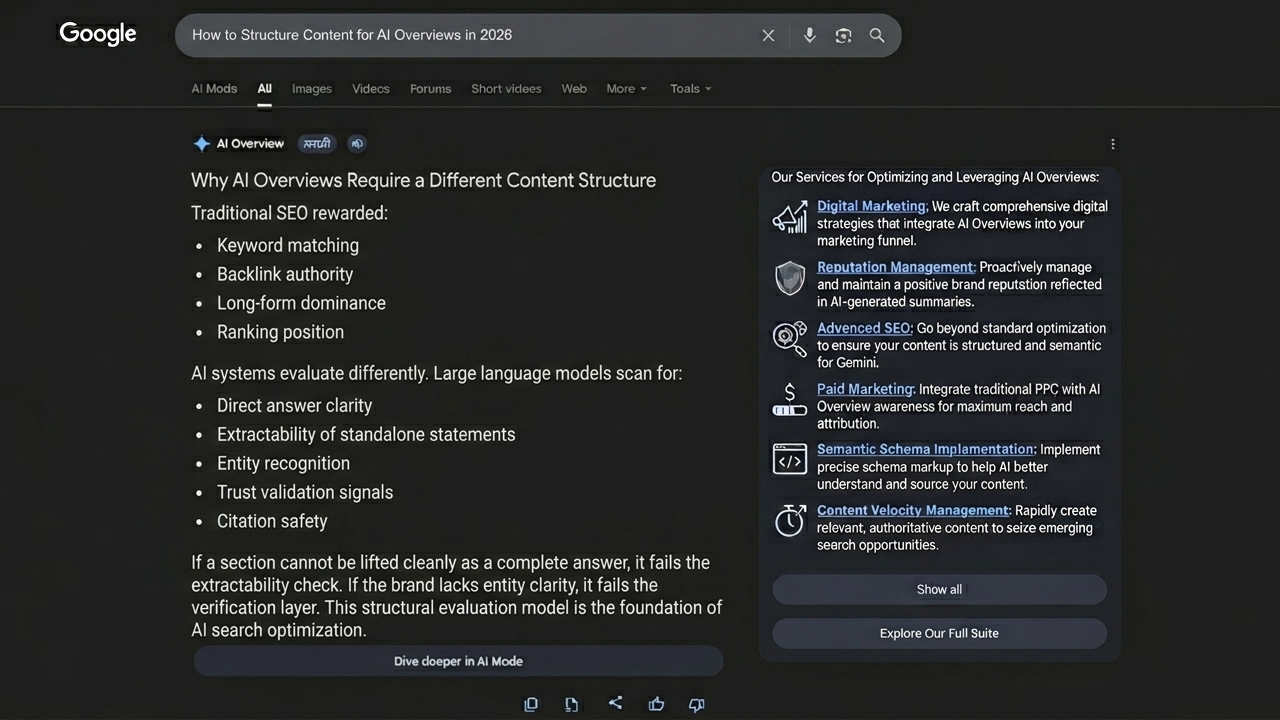
Why AI Overviews Require a Different Content Structure
Traditional SEO rewarded:
- Keyword matching
- Backlink authority
- Long-form dominance
- Ranking position
AI systems evaluate differently. Large language models scan for:
- Direct answer clarity
- Extractability of standalone statements
- Entity recognition
- Trust validation signals
- Citation safety
If a section cannot be lifted cleanly as a complete answer, it fails the extractability check. If the brand lacks entity clarity, it fails the verification layer. This structural evaluation model is the foundation of AI search optimization.
The Three Pillars of AI Visibility
AI citation inclusion consistently depends on three structural foundations.
1. Entity Establishment
Before AI systems cite your content, they must clearly recognize your brand as a defined entity. That recognition requires:
- Knowledge Graph presence
- Consistent business data across platforms
- Structured Organization schema
- Verified entity relationships
- Complete Google Business Profile information
AI audits reveal that nearly 89% of brands lack a Knowledge Panel, while 72% operate with incomplete business profiles. Without entity clarity, citation probability drops dramatically.
Entity recognition is the first layer of AI search optimization.
2. Citation Architecture
Many pages ranking #1 fail to appear in AI answers because they are not structured for extraction.
LLMs evaluate content in four stages:
- Relevance Matching – Does this directly answer the query?
- Extractability – Can a statement be cited independently?
- Verification – Is the source credible and structured?
- Citation Priority – Is this entity safe to recommend?
AI visibility audits found that 5,000 word narrative articles frequently received zero citations, while concise 800 word structured pages achieved a 68% citation rate. Length does not drive AI visibility. Structure does. This is where on page SEO services must evolve beyond keyword placement and focus on information architecture.
3. Trust Signal Reinforcement
AI systems operate conservatively. They prefer entities with measurable trust reinforcement, including:
- Review authority
- Media mentions
- Author credibility
- Consistent brand positioning
- Positive sentiment signals
Even minor inconsistencies in brand data weaken citation confidence. Technical SEO services must therefore align with reputation strategy to reinforce entity trust scoring.
How to Structure Content for AI Extractability
AI-ready content follows a disciplined architecture rather than narrative sprawl.
Use Question-Based Subheadings
Headings should mirror real user queries:
- What Is AI Search Optimization?
- How Do AI SEO Services Improve Citation Visibility?
- What Does a Technical SEO Audit Include?
Clear H2 and H3 hierarchy improves NLP segmentation and AI parsing.
Begin With a Direct 1–2 Sentence Answer
Each major section should open with a concise definition before expansion.
Example:
AI search optimization is the process of structuring content and entity signals so generative systems can confidently extract and cite your brand in synthesized answers.
This structure aligns with AI summary formatting.
Follow the Zero-Click Content Framework
High-performing AI-ready pages typically follow this sequence:
- Clear claim-based section title
- One-sentence articulation of the problem
- Supporting data points
- Structured solution steps
- Clear takeaway
This improves both user comprehension and citation probability.
The Role of Schema in AI Visibility
Structured data is not optional in 2026. Four schema types influence the majority of AI recognition:
- Organization schema (entity clarity)
- FAQ schema (extractable answers)
- Article schema (authorship validation)
- Aggregate rating schema (trust reinforcement)
FAQ schema produces some of the highest AI citation inclusion rates because it mirrors AI Overview formatting. A comprehensive technical SEO audit should validate structured data accuracy before scaling content production.
Keyword Strategy for AI Overviews
AI Overviews frequently trigger on conversational long-tail queries, often under 100 monthly searches. However, high-volume keywords remain strategically valuable when structured properly. Core keywords such as AI SEO services, AI search optimization, technical SEO services, SEO competitor analysis, technical SEO audit, AI SEO tools, and on page SEO services should be integrated into question-based headers and structured explanations rather than repeated unnaturally.
AI models reward contextual authority and semantic alignment, not keyword density.
SEO competitor analysis now includes reviewing which competitors are cited in AI answers and reverse-engineering their structural formatting.
Three Immediate Structural Wins
Brands looking to increase AI inclusion can prioritize three actions:
Establish Entity Clarity
- Complete Knowledge Graph data
- Standardize brand information
- Implement Organization schema
Improve Extractability
- Restructure top 5 pages with question-based headers
- Add direct-answer openers
- Implement FAQ schema
Strengthen Trust Signals
- Generate review authority
- Respond consistently
- Reinforce external mentions
These adjustments often produce measurable visibility changes within 30–60 days.
Common Structural Mistakes That Block AI Inclusion
Several recurring issues suppress AI citation probability:
- Schema without accurate entity data
- Overly long narrative content without segmentation
- Inconsistent brand descriptions across platforms
- Weak review signals
- No contextual internal linking
Each of these reduces entity confidence, even when rankings remain stable.
The Future of AI Search Optimization
AI search traffic has grown more than 527% year-over-year. AI chatbots now account for a rapidly expanding share of informational searches, and approximately 35% of Gen Z users report using AI tools as a primary search method. LLM-driven discovery models are accelerating, and generative systems are increasingly shaping user decisions before clicks occur. Search has transitioned from position-based competition to inclusion-based competition.
Ranking is necessary. Citation is decisive.
Brands investing in structured AI SEO services, comprehensive technical SEO services, disciplined on page SEO services, and ongoing technical SEO audit frameworks will shape the answers users see, not just the results they scroll past. Structuring content for AI Overviews is no longer a formatting tactic. It is strategic infrastructure.