

WebiMax Blog

Digital marketing tips and advice.

May 29, 2026

Most businesses believe lead generation is a visibility problem. When leads slow down, they invest in SEO, increase advertising budgets, launch new campaigns, publish more content, or experiment with additional acquisition channels. The assumption is simple: more visibility creates more opportunities. While visibility certainly matters, it is only half of the equation.

Read Story

May 29, 2026

May 29, 2026

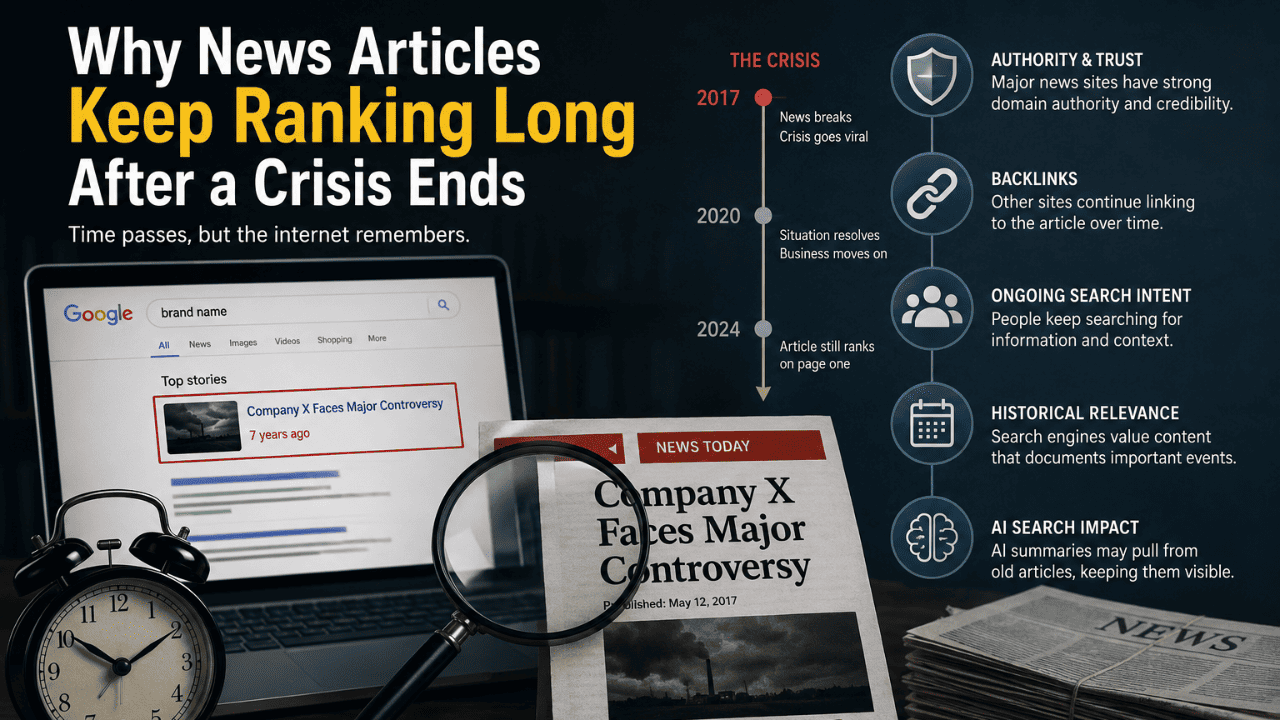
A company experiences a public controversy. News outlets cover the story extensively, social media amplifies the discussion, customers react, and industry commentators weigh in with their opinions. Over time, the situation is resolved. Leadership changes. Internal processes improve. The business evolves and moves forward. Yet years later, when someone searches for the company on Google, the same crisis-related articles continue appearing prominently in search results. For many organizations, this becomes one of the most frustrating realities of modern online reputation management. The crisis may be over, but the visibility of that crisis often remains.

Read Story

May 29, 2026

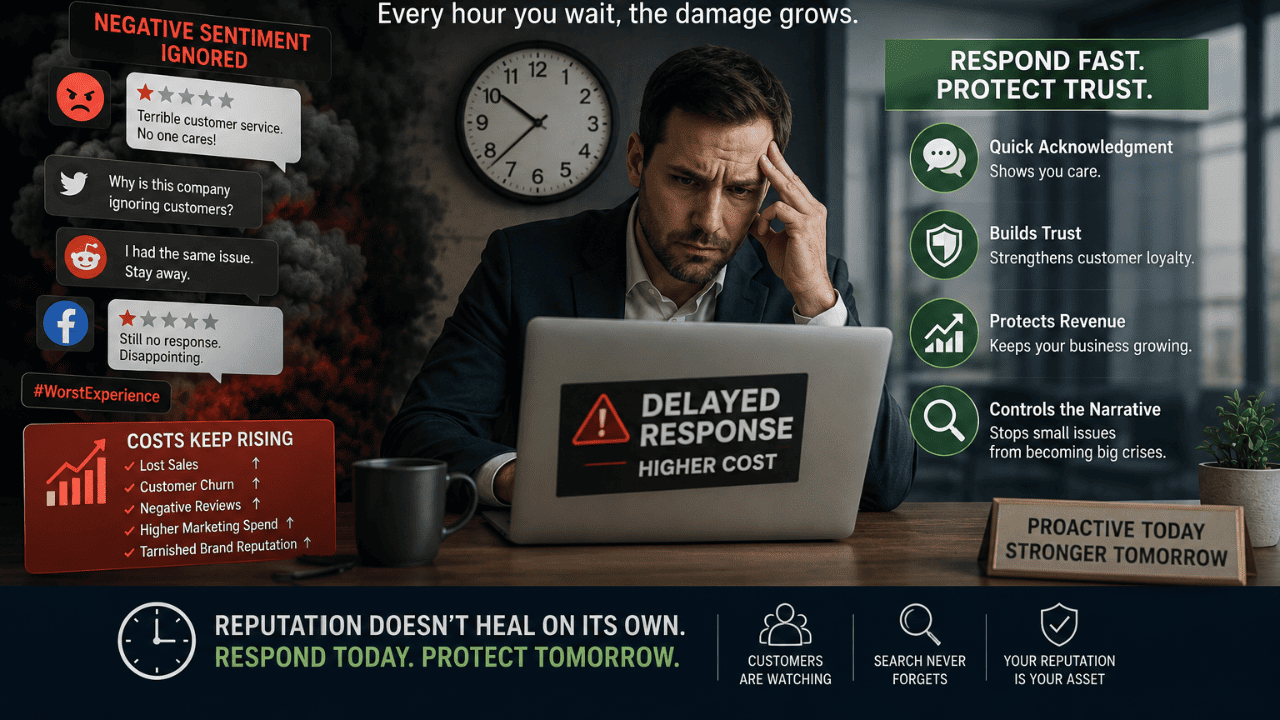
Most businesses fear the moment their brand becomes the center of negative attention online. A controversial campaign, a customer complaint that gains traction, an executive misstep, or a poorly handled situation can spread across social media within hours, reaching millions of people before internal teams have even fully assessed the situation. While the immediate backlash often feels overwhelming, the viral moment itself is rarely what causes the most long-term damage. What determines whether a business recovers or struggles for years afterward is how effectively it manages the loss of trust that follows. This is why modern brand reputation management has become one of the most important investments organizations can make in today's digital landscape.

Read Story

May 28, 2026

Online reputation risks are no longer limited to:

Read Story

May 28, 2026

A modern reputation management agency increasingly understands that consumers now trust authentic user evidence more than polished brand statements across digital environments.

Read Story

May 28, 2026

A modern reputation management agency increasingly plays a critical role in how businesses strengthen visibility, customer trust, and long-term digital growth across competitive online environments.

Read Story

May 27, 2026

In today’s digital landscape, keywords and ad copy no longer drive performance marketing. Before customers click an ad, fill out a form, or make a purchase, they often do something else first: they validate the brand behind the message.

Read Story

May 27, 2026

May 27, 2026

May 27, 2026

May 26, 2026

A modern reputation management agency increasingly plays a critical role in how businesses maintain digital trust, visibility, and consumer confidence across online ecosystems.

Read Story

May 26, 2026

AI-driven search systems are fundamentally changing how online reputation management influences digital trust. Brands are no longer evaluated solely through rankings or website performance but through the consistency, credibility, and behavioral trust signals distributed across the broader digital ecosystem.Read Story

May 26, 2026

AI-driven search systems are fundamentally changing how online reputation management influences digital visibility. Brands are no longer evaluated solely by rankings but by the trust signals, authority layers, and reputation consistency AI systems detect across the broader web ecosystem.Read Story

May 25, 2026

Modern CRO increasingly depends on user trust for better conversions because users rarely convert immediately after discovering a brand, service, or landing page. Before taking action, users typically evaluate credibility, relevance, safety, professionalism, and behavioral reassurance throughout the digital experience.Read Story

May 25, 2026

Imagine your business is thriving. Sales are up, customers are happy, and your team is performing well. Then, a single negative review, a misstep by an employee, or an unforeseen product issue goes viral online. Suddenly, your brand’s hard-earned image is under attack, and your team scrambles to respond. This reactive approach, treating reputation management as an emergency "fire drill," is a common but ultimately unsustainable strategy for businesses today.

Read Story

May 25, 2026

Modern CRO increasingly depends on reducing cognitive load in website design because users no longer navigate digital experiences patiently or sequentially. Instead, they scan rapidly, evaluate relevance instantly, and make behavioral judgments within seconds. This makes cognitive load in website design one of the most important factors influencing user engagement, trust progression, and conversion behavior in modern UX.

Read Story

May 25, 2026

Modern UX increasingly depends on adaptive web design because users no longer navigate websites through predictable, linear journeys. Search behavior has become fragmented, intent-driven, AI-influenced, and highly contextual. As a result, modern websites must adapt dynamically to changing user expectations, behavioral signals, and decision pathways in real time.Read Story

May 22, 2026

Modern behavioral website structure strategies are becoming increasingly important because users no longer navigate websites in predictable or uniform ways. Different visitors arrive with different goals, expectations, urgency levels, and behavioral patterns, meaning modern websites must organize content around user behavior rather than static page hierarchies alone.Read Story

May 22, 2026

Modern UX and CRO increasingly depend on information scent because users rarely navigate websites randomly. Most people move through digital experiences by following informational cues that suggest relevance, value, clarity, and goal progression. When information scent is weak, users become uncertain, disengaged, and significantly less likely to convert.Read Story

May 22, 2026

Modern CRO increasingly depends on landing page relevance because users form expectations long before they arrive on a website. Search queries, Google results, PPC ads, AI-generated answers, and meta descriptions all shape psychological assumptions about what users expect to experience after clicking.

Read Story

May 21, 2026

Modern CRO focuses on why users delay conversion decisions online, since most conversion failures do not result from traffic problems alone. Often, users already have interest, awareness, and even purchase intent, but still hesitate due to psychological uncertainty, behavioral friction, and trust-related concerns. Read Story

May 21, 2026

Most businesses still approach conversion rate optimization as a page-level problem. If conversions are low, they redesign the CTA, shorten the form, change the headline, run another A/B test, or adjust button colors hoping performance improves. But despite years of CRO best practices, the average website still converts only a small percentage of its traffic. Industry benchmark reports consistently place average website conversion rates between roughly 2% and 5% across most industries, while even small friction points continue to create measurable abandonment increases throughout conversion journeys.

Read Story

May 20, 2026

Imagine pouring significant resources into ranking for a high-volume keyword, only to find your traffic doesn't translate into meaningful leads or sales. This isn't an isolated incident; it's a growing reality for many businesses. The traditional pursuit of top rankings for broad, high-traffic keywords is yielding diminishing returns. You're likely feeling the pressure to justify your SEO investment, wondering why the old playbooks aren't working as effectively.

Read Story

May 20, 2026

Modern CRO increasingly depends on scroll depth optimization because users rarely abandon webpages instantly. Most disengagement happens gradually through attention fatigue, trust loss, cognitive overload, and declining informational relevance as users move deeper into a page experience.

Read Story

May 20, 2026

Users begin deciding whether to trust a website long before they read an entire landing page. In modern conversion environments, above-the-fold trust signals often determine whether visitors continue exploring or abandon the experience within seconds.

Read Story

May 20, 2026

A landing page can look visually polished, load quickly, and still fail if it misunderstands why the user arrived in the first place. In modern digital environments, landing pages fail at intent far more often than they fail at design.Read Story

May 19, 2026

The words users encounter on a landing page influence far more than readability or branding. In modern digital environments, landing page copy directly shapes how users interpret risk, evaluate value, process trust, and make decisions.Read Story

May 19, 2026

Users rarely abandon a landing page because a button was the wrong color. More often, they leave because the page failed to align with what they expected to find. Businesses run CRO tests , or conversion rate optimization tests, to improve how effectively landing pages turn visitors into leads, sales, or inquiries. These experiments typically involve testing variations of headlines, CTAs, layouts, forms, or messaging to understand what drives stronger user action. However, a surprising number of CRO tests fail not because the experiments themselves are technically flawed, but because the pages being tested never aligned with user intent in the first place.Read Story

May 18, 2026

In modern web design, CTA placement is no longer just a UX choice; it is a behavioral strategy tied directly to conversion psychology. Modern users do not interact with w ebsites in linear ways anymore. They scan, evaluate, compare, hesitate, and make micro-decisions within seconds. This is why CTA placement has become one of the most important elements of conversion-focused web design.Read Story

May 18, 2026

Why Modern Landing Pages Must Do More Than Look Good. Most businesses still consider landing pages to be digital brochures, pages designed to present information, showcase services, and encourage conversions through strong visuals and persuasive copy.Read Story

May 15, 2026

Search Engines Are No Longer Only Ranking the Present. Predictive SEO is reshaping how websites compete in modern search environments. AI-driven ranking systems are no longer evaluating content only based on current keyword relevance or historical authority. Instead, modern search engines increasingly attempt to estimate the future value of content before long-term engagement signals fully develop.Read Story

May 15, 2026

Why do some websites continue struggling with rankings even after publishing high-quality content, improving technical SEO, and building topical depth? In many cases, the issue is not content quality; it is structural conflict within the website itself.Read Story

May 14, 2026

When does More Content Start Weakening SEO ? And why do websites lose rankings even while publishing more content than ever before? For years, SEO strategies were built arou nd expansion. The assumption was simple: more pages meant more keyword opportunities, more indexed URLs, and more search visibility. But modern AI-driven search systems no longer evaluate websites based on content volume alone.Read Story

May 14, 2026

Search Results Are No Longer Built from Single Pages. Why do modern search results often feel less like lists of websites and more like synthesized answers? The reason is that AI-d riven search engines no longer rely on isolated pages to generate rankings and responses. Instead, they increasingly construct search experiences by combining signals, insights, and contextual information from multiple content sources simultaneously.Read Story

May 13, 2026

Why Do Certain Pages Keep Dominating Search Results ? Why do some pages continue attracting rankings, backlinks, visibility, and engagement long after publication, while others struggle to gain traction even with solid optimization? The difference often comes down to what can be des cribed as content gravity in SEO.Read Story

May 13, 2026

Why do some websites feel easier for search engines to understand, even before analyzing the actual content? The answer often lies in the navigation structure . Modern search engines no longer treat website menus as simple usability features. AI-driven ranking systems now interpret navigation as a structural signal that helps define topic hierarchy, semantic relationships, and content importance across a website.Read Story

May 12, 2026

Why Do Some Websites Feel “Deeper” to Search Engines? Why do certain websites consistently dominate search visibility across dozens of related queries while others struggle to rank beyond a few isolated pages? The difference often depends on how search engines interpret content depth. Modern AI-driven search systems no longer evaluate pages independently; they evaluate how information expands, connects, and evolves across an entire website.

Read Story

May 12, 2026

In 2026, SEO is no longer just about keywords or backlinks; it is about meaning systems. Search engines powered by AI now interpret websites based on context, relationships, and consistency across content ecosystems. This is where semantic conflict in SEO becomes a critical issue.Read Story

May 11, 2026

As AI-driven search continues evolving in 2026, search intent-based site structure is becoming one of the most important foundations of modern SEO. Search engines no longer evaluate websites solely through keywords or backlinks. Instead, AI systems analyze how content pathways align with user intent, decision stages, and behavioral progression across an entire website. Read Story

May 11, 2026

In 2026, site structure for SEO has become one of the most important foundations of modern search visibility. AI-driven search engines no longer evaluate websites as isolated pages; they interpret them as interconnected knowledge environments where hierarchy, semantic relationships, and contextual organization influence how content is understood and surfaced. Read Story

May 8, 2026

HubSpot recently reported that more than 75% of marketers now use AI tools within their content workflows, while Google continues expanding AI Overviews across commercial and informational search results simultaneously. But despite businesses publishing more content than ever before, many are experiencing declining organic clicks, weaker engagement quality, and lower search influence overall.Read Story

May 8, 2026

Search behavior is changing faster than most businesses realize. According to the research, nearly half of consumers now use AI-powered search experiences during decision-making journeys, and 44% of AI-search users already consider AI-driven search their primary source of information over traditional search engines.

Read Story

May 7, 2026

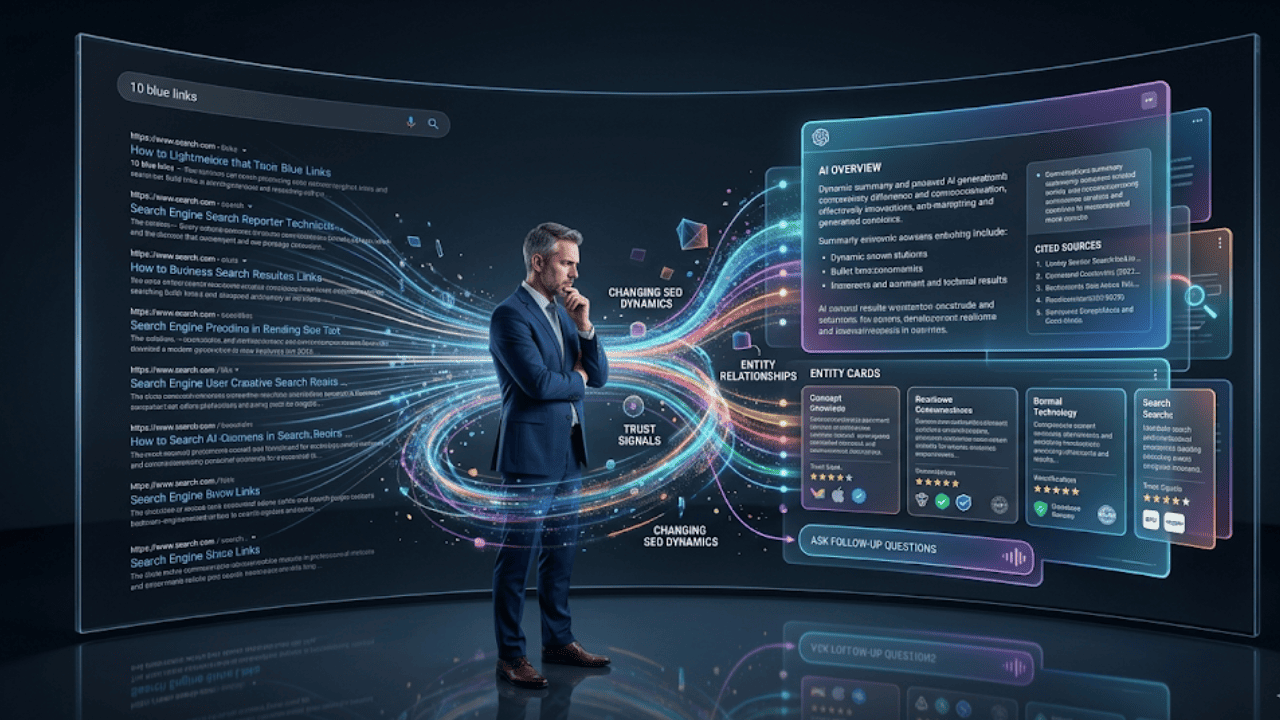
They are becoming interpretation systems that summarize information, validate authority, compare sources, and increasingly decide which brands deserve inclusion inside AI-generated answers before users ever click a result. This shift is fundamentally changing how businesses should approach AI SEO because rankings alone no longer guarantee meaningful exposure.Read Story

May 7, 2026

For years, businesses approached SEO with a relatively straightforward objective: rank higher, attract more clicks, and generate more traffic. That framework shaped entire digital marketing strategies because traditional search engines primarily functioned as discovery systems. A user entered a query, Google returned ranked pages, and the highest positions captured the majority of visibility.Read Story

May 6, 2026

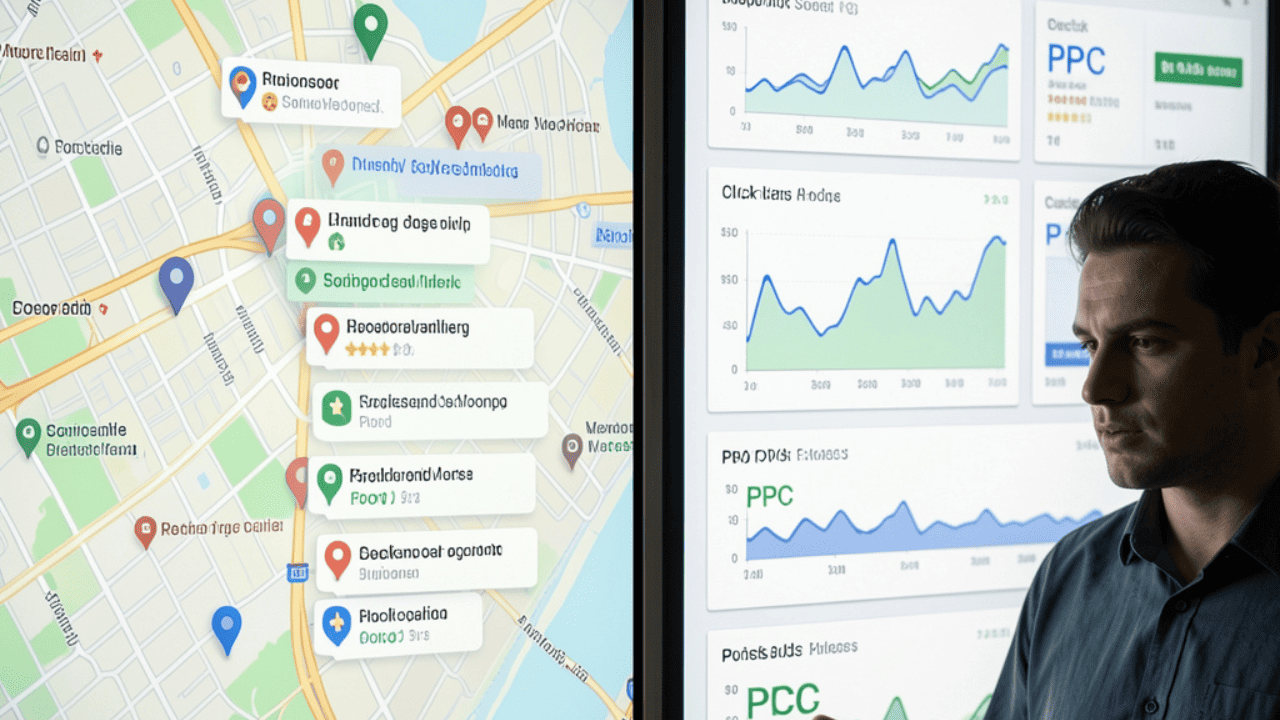
Most businesses compare Local SEO and Google Ads as if they solve the same problem. They do not. One builds long-term demand capture and trust accumulation. The other buys immediate visibility within a competitive auction system. That distinction matters because local customer acquisition is rarely determined by traffic alone. In most markets, the business that wins is usually the one that reduces decision friction fastest. Read Story

May 6, 2026

Let me paint you a picture that might feel uncomfortably familiar. You open your Google Business dashboard on a Tuesday morning and the numbers look decent. You're showing up on Maps. Your listing is getting impressions. Website traffic is steady, maybe even growing compared to last quarter. Someone on your team even celebrated last month when you cracked the first page for three new search terms. By every visible measure, your local marketing is doing its job.Read Story

May 5, 2026

Most businesses assume Google Maps works like a listing directory. You create a profile, verify it, add details, and expect to show up when someone searches for your services. But that assumption is exactly why most businesses fail to rank.Google Maps is not a directory. It is a decision engine.Read Story

May 5, 2026

Modern AI Search Optimization is no longer about matching queries to keywords. Search engines have evolved into answer-generation systems that interpret intent, context, and meaning before deciding what content to surface.Read Story

May 4, 2026

Most businesses don’t lose customers because they are invisible. They lose customers because they are not chosen. They show up in local search. They rank on Google Maps. Their listings are active, optimized, and visible across platforms. On paper, everything appears to be working. But when you look at actual outcomes, the gap becomes clear. Calls are inconsistent, inquiries fluctuate, and conversions fail to scale with visibility. This is not a visibility problem. It is a decision problem.Read Story

May 4, 2026

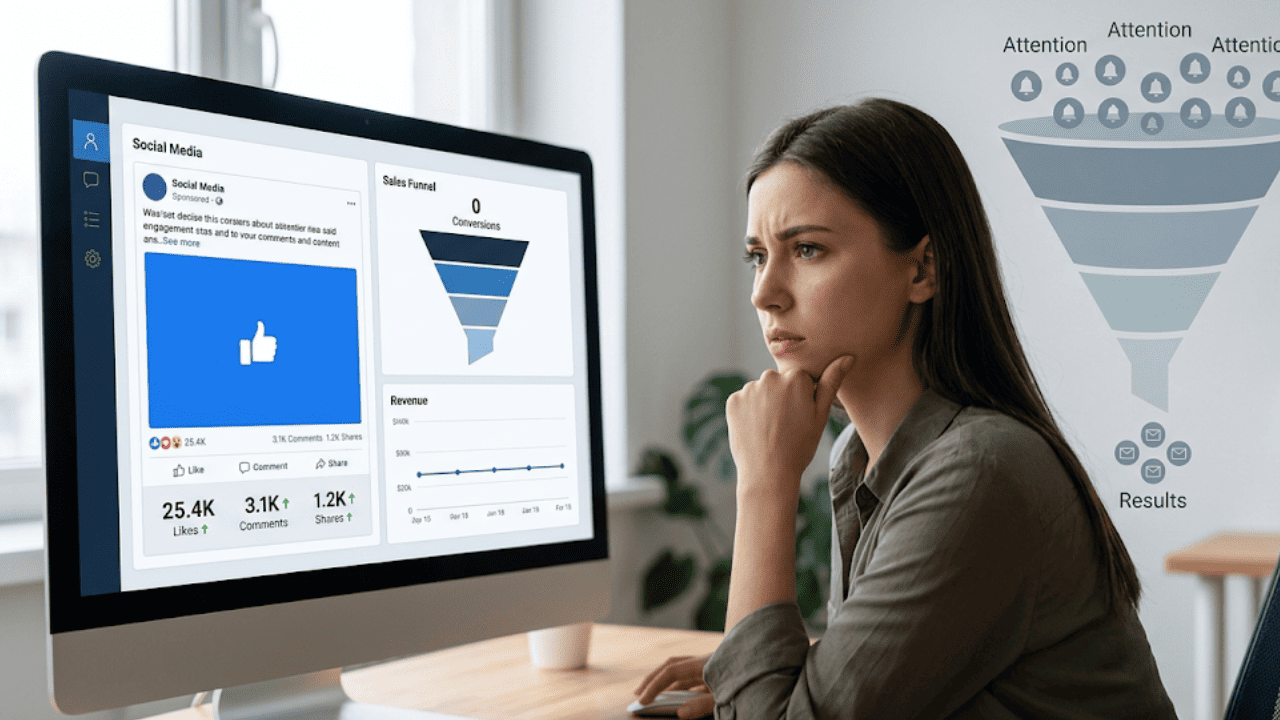
Most businesses don’t struggle with visibility on social media. They struggle with what comes after it. Posts perform well. Engagement grows steadily. Metrics suggest momentum. But when those numbers are traced back to actual outcomes, the disconnect becomes clear.Read Story

May 1, 2026

For most businesses, social media performance appears active but unclear. Content generates engagement, traffic increases, and leads occasionally come through, but connecting these outcomes directly to revenue remains difficult. This is known as the social media attribution problem.

Read Story

May 1, 2026

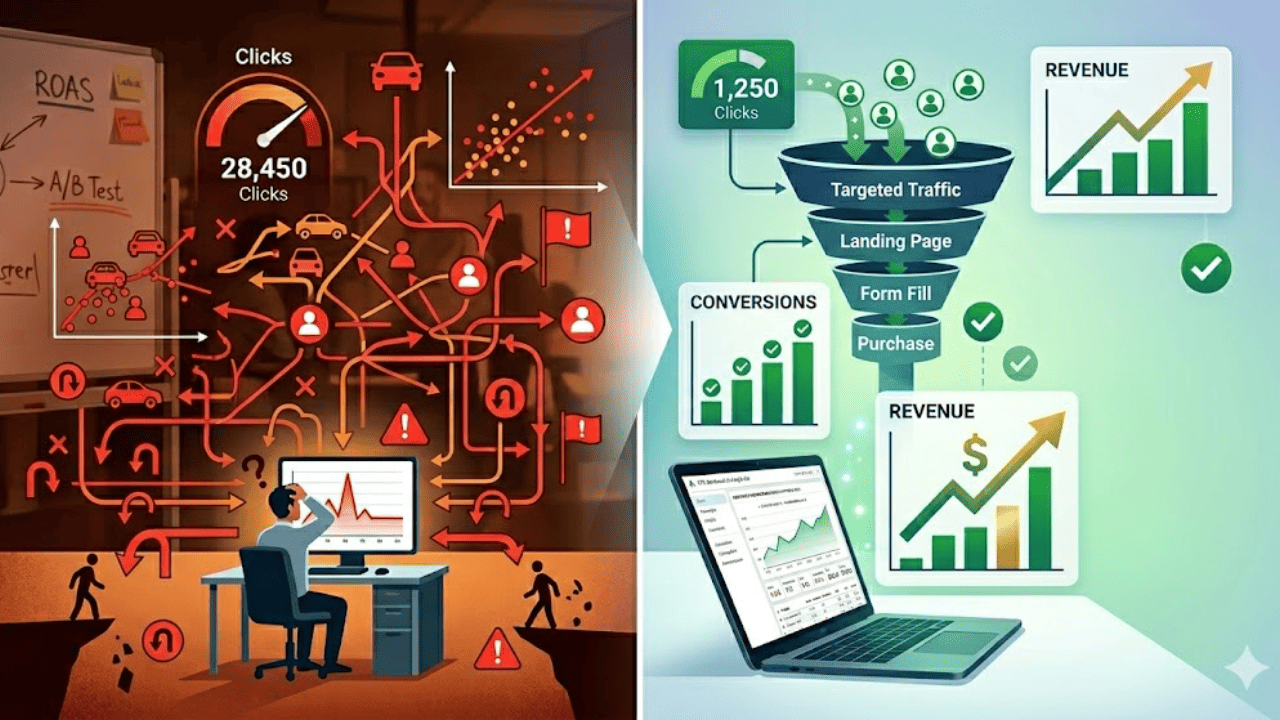
Most PPC campaigns don’t underperform because they lack traffic. They underperform because they are optimized for the wrong signal. Clicks create the illusion of progress. Dashboards look active, CTR improves, and campaigns appear healthy. But clicks are not revenue. They are just unqualified entry points into a system that may not convert .Read Story

Get a Free Custom Marketing Proposal

WebiMax has helped hundreds of businesses across industries rank higher, generate more leads, and build a stronger brand online. Our services include SEO, Paid Search, Reputation Management, Web Design, and more. Contact info@webimax.com to receive your free proposal today!

🆓 100% Free & No Obligation

Is Your Website Ready for the AI Search Era?

Get a free analysis across SEO, AI SEO, GEO & AEO, and see exactly what's holding you back.

Search has changed. WebiMax helps businesses get found everywhere from Google to ChatGPT and beyond. Our experts cover:

AI SEO GEO AEO SEO PPC Reputation Mgmt Lead Generation Web Design
  • Free in-depth website & SEO health report
  • AI search visibility check (GEO & AEO audit)
  • Competitor ranking analysis
  • Custom strategy tailored to your goals
🔍 Get My Free Website Analysis 📅 Book a Free Consultation

Or email us directly: info@webimax.com

More...

Subscribe to Updates